


Japandi at Home: How to Achieve the Look With Floating Shelves and Minimal Wooden Pieces
This in-depth guide explains the Japandi style, a blend of Scandinavian restraint and Japanese wabi-sabi, and how to achieve it with floating shelves, wall-mounted nightstands, and minimal wooden pieces. It covers material honesty, combining wood tones like walnut, oak, and ash, room-by-room applications, common mistakes, and where to start.
A practical guide to the aesthetic that has quietly taken over modern interiors — and why less really does mean more.
There is a reason Japandi keeps appearing in every interior conversation. It is not a trend in the usual sense — not something that arrives loudly and disappears in a season. It is a philosophy: the idea that a home should feel calm, purposeful, and honest about its materials. Scandinavian restraint meets Japanese wabi-sabi, and the result is something most people recognise the moment they walk into it, even if they cannot immediately name it.
The good news is that achieving it does not require a complete renovation or a significant budget. More often than not, it comes down to a handful of carefully chosen handmade wooden pieces and the discipline to stop there. The bad news, if you can call it that, is the discipline part. Anyone can buy a walnut shelf. Knowing when to stop adding things to it is the actual skill.

Chapter 1: What Japandi Actually Means (And What It Does Not)
Japandi is sometimes simplified to "minimalism with warm wood tones," and while that is not wrong, it misses the intention behind it. The aesthetic is rooted in the idea that every object in a space should earn its place — not through decoration alone, but through genuine usefulness. A floating wall shelf is Japandi not because it is made of walnut, but because it holds exactly what it needs to hold and nothing else. A floating nightstand belongs in a Japandi bedroom not because it is beautiful, but because it removes clutter from the floor while bringing natural material to eye level.
The distinction matters because it changes how you shop. Instead of asking "does this look right?" you ask "does this do something, and does it do it without drawing too much attention to itself?"
What Japandi is not: it is not bare, cold, or stark. Scandinavian minimalism can sometimes tip into austerity; Japanese interiors can feel austere to Western eyes. Japandi sits between the two, using natural wood tones, soft textiles, and considered negative space to create rooms that feel inhabited and restful at the same time. A genuinely Japandi room should still feel lived in — you should be able to tell someone makes tea there, reads there, falls asleep there. A showroom doesn't qualify, no matter how much walnut is in it.
Chapter 2: The Materials That Define the Aesthetic
Natural wood is the foundation of any Japandi or minimalist home design. Not painted wood, not heavily lacquered wood, but wood that shows its grain, its variation, its honesty. Oak, walnut, ash, cherry, and wenge all sit naturally within the Japandi palette — each brings a different warmth without fighting for attention.
The finishes that work best are matte or lightly oiled. Glossy surfaces reflect too much light and break the calm that Japandi depends on. A floating wood shelf in walnut with a natural matte finish will work in a Japandi space in a way that a glossy lacquered alternative simply will not — the gloss reads as "furniture store," the matte reads as "this has been here a while and it's fine."
For shelving specifically, what the wood sits on top of matters almost as much as the finish. A lot of budget floating shelves are MDF or particleboard underneath a wood-look laminate, which is the opposite of the Japandi principle of material honesty — and it shows over time, since MDF chips at the edges and swells if a room gets humid. A real plywood core with a genuine wood veneer surface holds up to daily use and keeps its shape, which matters more in a bedroom or bathroom than people expect until the cheap version starts looking tired after a year.
Beyond wood, Japandi uses natural textiles (linen, cotton, wool), ceramic and stone accents, and occasionally brass or matte black metal as a restrained accent. The rule is that no single material should dominate. Wood does the heavy lifting; everything else supports it quietly.
Chapter 3: Wood Tones and How to Combine Them
One of the most common mistakes in Japandi interiors is treating wood as a single category. In practice, different wood tones have very different effects, and mixing them deliberately — rather than accidentally — is what gives a room its character.
Walnut is the deepest and richest. It brings warmth and depth without being heavy, and it works particularly well in rooms with lighter walls and natural light. A walnut floating shelf or a walnut wall-mounted nightstand anchors a room without dominating it.
Oak is the most versatile. It sits between warm and cool, adapts to almost any palette, and ages beautifully. A floating oak shelf reads as calm and considered in almost any context, which is why it's usually the safest first choice if you're not sure yet.
Ash is lighter and more neutral, and it is the natural choice when a room already has darker elements or when the goal is maximum airiness.
Cherry and wenge sit at opposite ends of the spectrum — cherry warm and reddish, wenge deep and almost black. Both work in Japandi spaces but reward more care: use them as the single lead tone in a room rather than mixing either with two or three other dark woods.
The Japandi approach to combining wood tones is simple: let one lead and the others follow. A walnut floating nightstand with an oak floating shelf on the opposite wall works because one is clearly primary. Three different dark woods in the same room stops looking intentional and starts looking like furniture accumulated over a decade without anyone deciding on a direction.
Chapter 4: Floating Shelves — The Most Japandi Piece You Can Own
Of all the pieces that fit the Japandi aesthetic, floating wall shelves are perhaps the most natural fit. The reason is structural as much as visual. A floating shelf with a hidden bracket appears to emerge from the wall rather than being fixed to it — the concealed mounting means there are no visible supports, no hardware on display, no interruption of the wall surface.
This matters in Japandi interiors because the aesthetic actively resists the visible mechanics of furniture. You do not want to see how things are attached or assembled. You want the result — the calm, the warmth, the surface — without the process. A wooden floating shelf with concealed mounting achieves exactly that, and it's one of the first pieces most people reach for when they start moving a room toward Japandi, because it changes the wall without changing the floor plan.
For weight and longevity, thickness matters more than most people assume before they own one. Most shelving guides put the meaningful threshold for anything holding real weight — books, storage boxes, a stack of plates — at around 4cm (roughly 1.5 inches); thinner than that and visible sag becomes a real risk over time, especially on longer spans. It also simply looks more deliberate on the wall at that thickness, less like an afterthought.
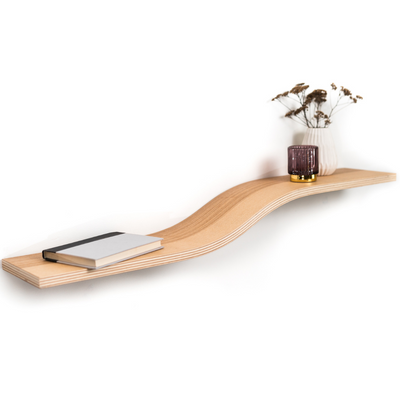
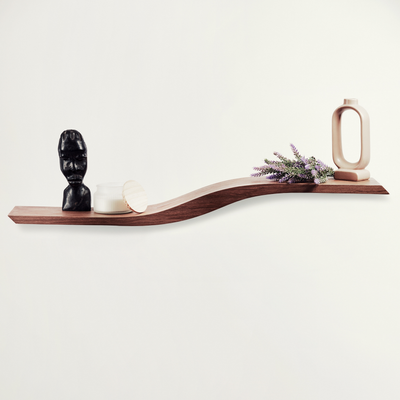
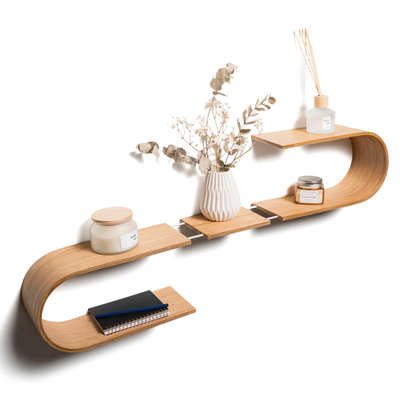
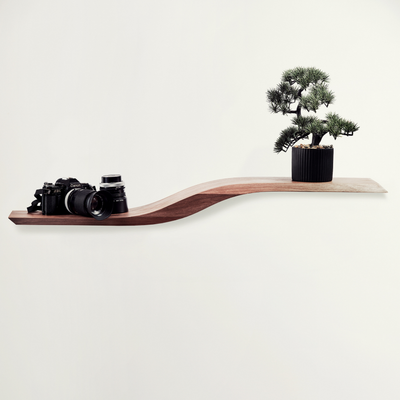
The shape of the shelf carries meaning too. A curved floating shelf — one with gentle, organic edges rather than sharp corners — introduces the kind of natural form that Japandi borrows from Japanese design traditions. Nothing in nature has perfectly sharp corners. A wavy bookshelf or a sculptural curved wall shelf brings that softness into a room without requiring anything decorative to be placed on it.

How to Style Floating Shelves the Japandi Way
Less is always more, though "less" has a specific shape here, not just a vague instruction to declutter. A single ceramic vessel, a small plant, and two or three books are enough for one shelf. A second shelf might hold just two things. The negative space between objects is not emptiness — it is breathing room, and it is as important as whatever you place there.
Wood tones should run through the shelf itself and the objects on it. A walnut floating shelf styled with a small wooden bowl and a linen-bound book creates a coherent vignette without any effort. A shelf crowded with mismatched objects in competing colours does the opposite, no matter how nice the shelf underneath them is.
For bedroom walls, floating shelves for the bedroom provide a surface for the things that would otherwise end up on the floor or piled on the nightstand: a book, a glass of water, a small plant, a candle. This is Japandi in practice — the shelf solves a real problem while adding warmth and natural material to the room. Used well, floating shelves in the bedroom become some of the most quietly effective unique home decor you can own.
Chapter 5: Floating Nightstands — Where Japandi Is Most Visible
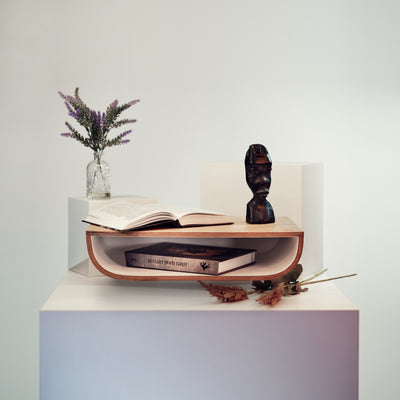
The bedroom is where Japandi has its greatest impact, and the floating nightstand is the piece that transforms the space most visibly. A traditional bedside table sits on the floor, takes up physical space, and requires the floor around it to be kept clear to look intentional. A floating nightstand is mounted to the wall, keeps the floor completely open, and brings the same function — a surface, sometimes a drawer or shelf — without the visual weight.
In a Japandi bedroom, floor space is protected. The fewer objects interrupting the floor plane, the larger and calmer the room feels. A wall-mounted wooden nightstand in oak or walnut creates the impression of a room that has been thoughtfully edited rather than simply furnished.
The proportions matter. A floating nightstand should be generous enough to hold what you actually use at night — phone, lamp, book, glass — but not so deep that it projects significantly from the wall. The relationship between the nightstand and the wall it is mounted on should feel like they belong together, not like something was bolted on as an afterthought.

Chapter 6: Room by Room — Japandi in Practice
The Bedroom
The bedroom is the natural home of the Japandi aesthetic. Low platforms or bed frames, natural linen, minimal bedside surfaces. A wall-mounted wooden nightstand on each side of the bed is the most efficient Japandi intervention available — it removes two pieces of floor furniture and replaces them with two wall-mounted surfaces that free up the room visually and physically.
A floating shelf in the bedroom serves a different function: display rather than immediate access. A single shelf above the headboard, styled with one or two carefully chosen objects, adds height and warmth to the wall without competing with the rest of the room.
The Living Room
Floating shelves in the living room follow the same logic as elsewhere: mount them to the wall, style them with intention, and resist the urge to fill them. A curved floating shelf above a sofa or along a plain wall becomes the focal point of the room without requiring anything elaborate on it. In this context, a well-chosen wood wall shelf is also one of the most effective pieces of modern wall decor available — it adds dimension and warmth to a flat surface without frames, prints, or anything that competes for attention.
The living room is also where Japandi tolerates slightly more warmth and layering than the bedroom. A grouping of two or three floating wall shelves at different heights — each styled simply — creates rhythm without clutter.
The Bathroom
The bathroom is often overlooked in discussions of Japandi, but it is one of the rooms where the aesthetic is most effective. A wooden floating shelf above the basin, holding a single plant and a ceramic soap dish, transforms the feel of the room entirely. Natural material in a bathroom context is grounding in a way that chrome and plastic are not — though it does mean choosing a shelf with a finish that can handle humidity, since not every wood product is built for that environment.
Wooden bathroom accessories carry the same logic further. A wooden toilet paper holder — particularly a wall-mounted design in walnut or oak that holds a spare roll and uses the natural grain as its only decoration — is a small detail that most people walk past without registering, but notice when it is missing. These pieces replace the generic with the considered, which is exactly what Japandi asks of every object in a space.

The Home Office
The home office is newer territory for Japandi, but it is one of the most rewarding rooms to apply the aesthetic to. A floating shelf at desk height holds the things that would otherwise pile up on the desk itself: a plant, a notebook, a small speaker. A wall-mounted wooden desk organiser keeps cables and stationery out of sight. The result is a workspace that feels calm rather than cluttered — which, it turns out, is also the condition most conducive to focused work.
Chapter 7: Common Mistakes to Avoid
Adding Too Much
The most common error in Japandi interiors is confusing it with a style that can accommodate many small decorative objects. It cannot. Every additional object requires justification. If you cannot say exactly why something is there, it should not be there.
Choosing the Wrong Finish
Glossy surfaces, high-sheen lacquers, and heavily polished wood all work against the Japandi aesthetic. The finish should reveal the wood rather than obscure it. Matte, oiled, or lightly satin finishes are almost always the right choice.
Ignoring Negative Space
Empty wall sections, open floor areas, and unstyled shelf space are not problems to be solved. They are features. Japandi rooms feel calm because they protect the spaces between things as deliberately as the things themselves.
Mixing Too Many Styles
A floating walnut shelf next to a brightly coloured industrial bracket, next to a reclaimed farmhouse beam, does not read as eclectic — it reads as undecided. Japandi requires commitment to its own visual language. That does not mean the whole house must match, but each room should feel internally consistent.
Rushing the Process
Japandi interiors are not built in a weekend, and the temptation to order everything at once is strong. The aesthetic rewards patience: living in a space, understanding what it actually needs, and adding one piece at a time. A single well-chosen floating wood shelf, installed and styled carefully, will do more for a room than five shelves added in one afternoon and never quite finished.
Chapter 8: Where to Start
If you are approaching a room from scratch, start with the wall surfaces. Floating shelves establish the tone of a room before any other furniture is placed, because they are fixed and visible from the moment you enter. Choosing one or two floating wall shelves in a natural wood finish — installed with concealed brackets, styled with restraint — gives you a reference point for every other decision in the room. They also make one of the most thoughtful housewarming gifts for exactly this reason: they are immediately useful, made from long-lasting materials, and say something considered about the person giving them.
If the bedroom is the priority, a wall-mounted wooden nightstand on each side of the bed is the highest-impact single change you can make. It removes furniture from the floor, introduces natural material at eye level, and immediately makes the room feel more considered.
In both cases, the principle is the same: choose less, choose well, and let the material do the work. The room will still get lived in — books will end up on the wrong shelf, someone will leave a mug on the nightstand overnight — and that's fine. Japandi was never about a house that looks untouched. It's about a house that looks like someone thought about it.

Products related to this article

Frequently asked questions
What is Japandi style?
Japandi blends Scandinavian restraint with Japanese wabi-sabi: calm, purposeful rooms built on natural wood, soft textiles, and deliberate negative space. Every object should earn its place through genuine usefulness, and the room should still feel lived in rather than staged.
What wood tones work in a Japandi interior?
Walnut brings depth, oak is the most versatile and safest first choice, ash adds lightness, and cherry or wenge work as a single lead tone. The rule when mixing: let one wood lead and the others follow, rather than combining several dark woods.
Why are floating shelves considered so Japandi?
A floating shelf with a hidden bracket appears to emerge from the wall with no visible supports or hardware, which matches Japandi's resistance to the visible mechanics of furniture. Curved organic shapes add the natural softness Japanese design favors.
How thick should a floating shelf be?
For anything holding real weight like books or stacked plates, around 4 cm (roughly 1.5 inches) is the meaningful threshold; thinner shelves risk visible sag over time on longer spans, and thicker shelves also look more deliberate on the wall.
How do I style shelves the Japandi way?
A single ceramic vessel, a small plant, and two or three books are enough for one shelf. The negative space between objects is breathing room, not emptiness, and wood tones should run through both the shelf and the objects on it.
What finish should Japandi wood furniture have?
Matte, oiled, or lightly satin finishes that reveal the grain. Glossy lacquered surfaces reflect too much light and read as furniture store rather than lived-in calm.
What is the highest-impact Japandi change for a bedroom?
A wall-mounted wooden nightstand on each side of the bed. It removes floor furniture, keeps the floor plane open, and brings natural material to eye level, instantly making the room feel edited rather than furnished.
What are common Japandi mistakes to avoid?
Adding too many decorative objects, choosing glossy finishes, filling every empty space, mixing too many styles in one room, and rushing by ordering everything at once. Japandi rewards patience and one well-chosen piece at a time. EWART WOODS floating shelves and nightstands are handmade in Europe from real wood with concealed mounting.









Its realy helpful post thank you.
Laisser un commentaire