


Why Metal Shelves Can Be So Much Thinner Than Wood
If you've ever shopped for shelves seriously, you've absorbed a rule: thin means flimsy. Heft it in your hands, and if it feels light and slim, be suspicious. It's decent advice. We've given a version of it ourselves.
It's also wrong about metal, and the reason is a single number.

The Number That Explains It
Engineers measure how stubbornly a material resists bending with something called the modulus of elasticity. Steel's sits at roughly 190 to 210 GPa. Oak, measured along the grain, comes in around 11 GPa. Pine is nearer 9.
Steel is somewhere between eighteen and twenty times stiffer than a good hardwood.
That's not a small edge. It means a sheet of steel a few millimetres thick resists bending about as well as an oak plank many times its thickness. A 4mm folded steel shelf and a 40mm oak one are not in the same argument — the steel one is, purely as a matter of material stiffness, harder to bend.
So when a metal shelf looks impossibly thin and still sits dead level with a plant on it, nothing suspicious is happening. That's just what steel does.
What That Actually Buys You on the Wall
Thinness is not really about strength. It's about how much the shelf announces itself.
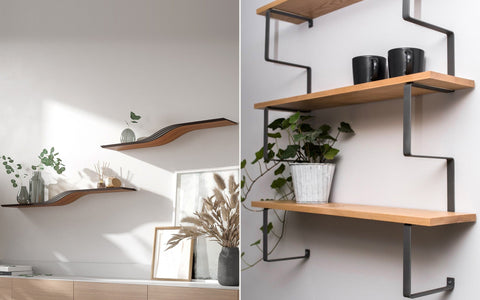
A thick shelf reads as an object with mass. It has a visible edge, it casts a shadow, and the eye registers it as furniture attached to the wall. A thin shelf reads as a line. Same footprint, entirely different visual weight.
Worth separating two words that get muddled here. Thickness is the slab itself, top face to underside, measured in millimetres. Depth is how far the whole thing projects out from the wall — a separate decision with its own consequences, which we've written about in what shelf depth actually does to a room. Two shelves can share a depth and look nothing alike, purely because of thickness. That's the property steel changes.
It also changes what shapes are possible. A curve cut into a 40mm plank looks heavy — there's simply too much material in the bend. The same curve in folded steel looks drawn. This is why metal wall shelves come in half moons, hexagons and perforated shapes that would look clumsy in timber, and it isn't a styling decision so much as a consequence of the material.

Where "Thin Means Flimsy" Is Still Right
Here's the part that matters, because the old rule isn't wrong so much as aimed at the wrong thing.
Material stiffness is one variable. Construction is another, and it's the one that actually fails. A shelf comes off a wall because of what's holding it, not because of what it's made of — thin internal rods, the wrong fixing for the wall type, load dumped at the front edge. We've been through those failure modes in detail in why floating shelves sag or fall, and every word of it still applies to metal.
So the refined rule is this. Thin material on a stiff metal is fine. Thin hardware is not, in any material. When you pick up a shelf and it feels flimsy, what you're usually detecting isn't the thickness of the panel — it's slack in the bracket, a loose fit, a mount that flexes when you twist it. That's the thing to be suspicious of, and it's independent of whether the shelf is 4mm or 40mm.
Judge the fixings. Ignore the millimetres.
The Other Thing Steel Doesn't Do
There's a second property worth knowing, and it has nothing to do with strength.
Wood is hygroscopic. It exchanges moisture with the surrounding air continuously and permanently, swelling as humidity climbs and shrinking as it drops. This is not a defect or a mark of cheap timber — it's simply what wood is, and decent joinery is designed to accommodate it rather than fight it.
Steel has no moisture content to gain or lose. Its dimensions don't respond to a damp week at all. Temperature shifts it very slightly, but indoor temperature swings are far too small for you to ever notice.
In a dry bedroom this is irrelevant. In a bathroom it isn't, which is why our metal shelves are powder-coated steel rather than bare — the steel doesn't move, and the coating handles the moisture. If you want the warmth of timber in a damp room instead, that's a real choice with real trade-offs, and we've compared them in wooden versus metal shelves.

What to Check Before You Buy a Metal Shelf
Three questions, in order of how much they matter.
What's the mount? Not the shelf — the thing holding it. Ask whether the fixings suit your wall, because that's where failures come from.
Is it coated, and how? Bare steel in a damp room is a slow problem. Powder coating is the durable answer: across standardised testing it consistently outperforms wet-applied paint and lacquer on hardness, chipping and corrosion resistance.
Is it welded or folded, or assembled? Continuous material is stiffer than joined material. A shelf pressed and welded from one piece behaves differently from one bolted together, regardless of thickness.
Notice that panel thickness isn't on the list. On steel, it's the least informative number you'll be given.
The Short Version
Thin metal isn't a compromise, it's a property. Nineteen-ish times the stiffness of oak means steel can be slim and still rigid, which is what lets a shelf read as a line on the wall instead of a slab bolted to it.
The old warning still stands, just pointed at the right target: check the hardware, not the millimetres. If you want to see how thin a shelf can reasonably get, our powder-coated steel wall shelves are the range where that's most obvious — handmade in Latvia, with free standard shipping worldwide.








Leave a comment